Adam lay ybounden,
Bounden in a bond;
Four thousand winter,
Thought he not too long.
And all was for an apple,
An apple that he took.
As clerkes finden,
Written in their book.
Ne had the apple taken been,
The apple taken been,
Ne had never our ladie,
Abeen heav’ne queen.
Blessed be the time
That apple taken was,
Therefore we moun singen:
Deo gratias!
* * * * * * * *
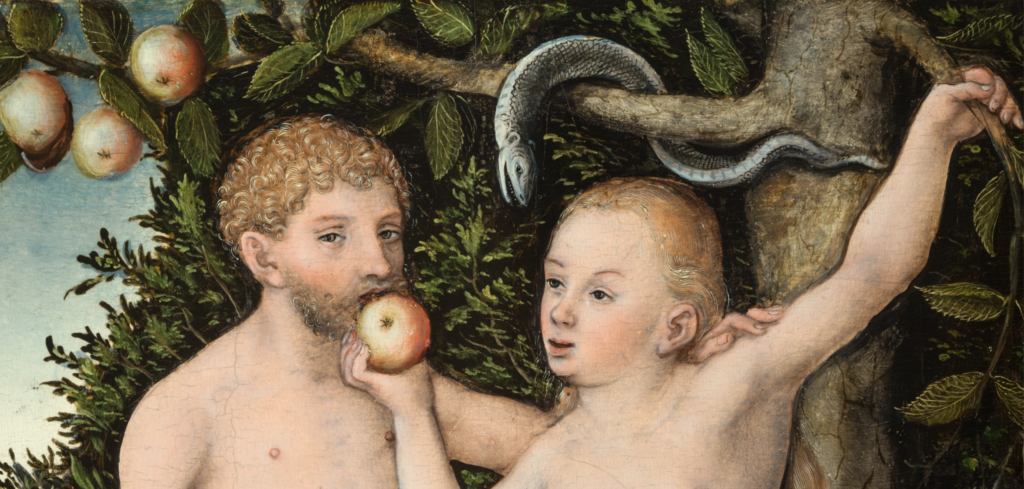
Most of us like apples: their sweet crispness when fresh; their warming softness when cooked. They are, indeed, a treasure of nature! And though Genesis doesn’t actually say the fruit of the tree of the “knowledge of good and evil” in the Garden of Eden was an “apple,” it is perhaps rather natural that the medieval mind came to identify the two together.
Yet, as good as they are, pause a moment and ponder the irony expressed by the anonymous minstrel who composed the Carol quoted above: Mankind, in Adam, traded the free and loving providence of God for… an apple. True, the serpent touted the supposed benefits of the fruit, implying that it contained within itself something that God was selfishly withholding from our first Parents: But even so, according to Genesis, the perception that the fruit “was good for food, that it was pleasant to the eyes,” rate even higher than the supposition that it was “desirable to make one wise” (Gen. 3:6)!
Is it not ever so with us mortal, hungry persons? Do we not seem, time and again, to go for tangible, desirable, material things in preference to the intangible, spiritual benefits that God longs to bestow upon us when the time is right?
“I want what is mine and I want it now” — this is the stark reality of the corrupted, impatient, grasping nature we have inherited due to the “fall.”
In this Advent, this season of hopeful expectation, may we patiently await the good gifts of our loving God. Let the texts of longing, enshrined in the Liturgy, remind us that we need not rush our celebration of our Lord’s coming among us, which was “in great humility.” Let us be content to wait: to fast, instead of rushing to grab what seems good and pleasing; to kneel in repentance, instead of hiding when God calls out to us; and to celebrate with deeper appreciation and greater joy the arrival of our blessed Savior in his Christmas Feast.
PAX,
Abbot Theodore
* * * * * * * *
“Adam Lay Ybounden” – Choir of King’s College, Cambridge