By an Oblate of Ladyminster
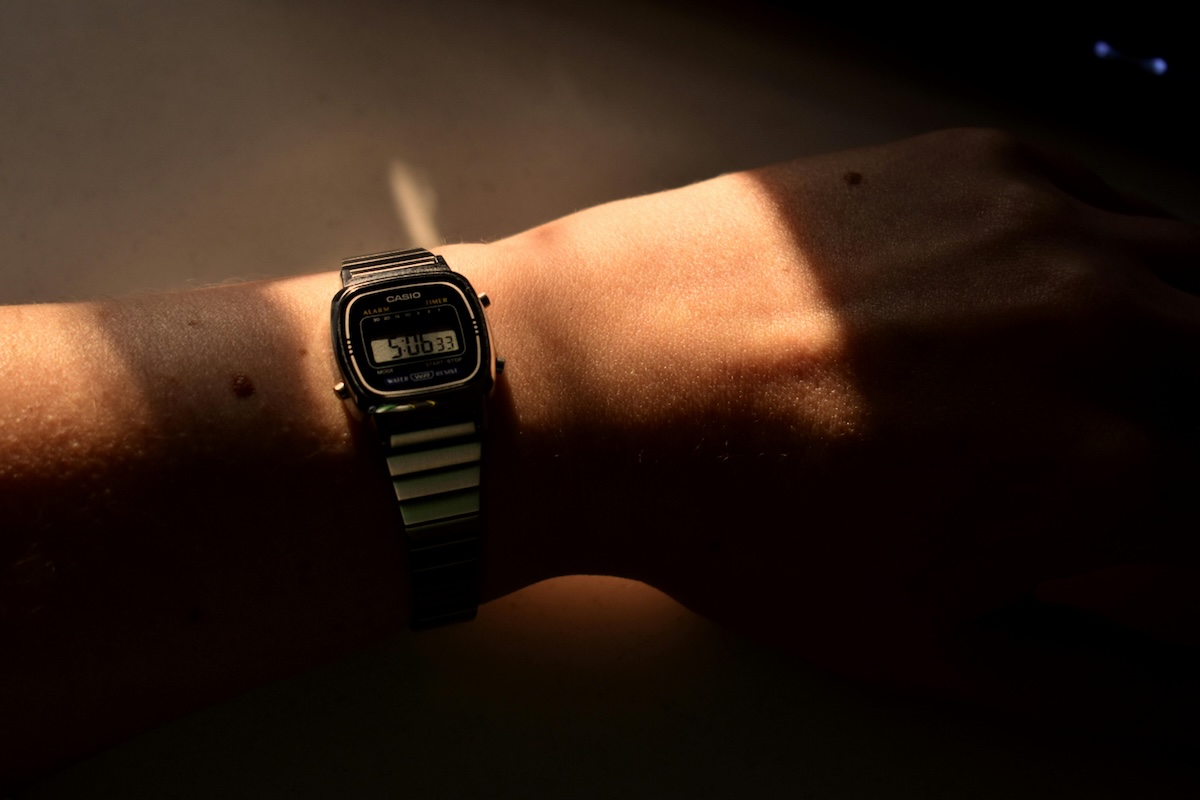
My fingers are busy tapping away on the keyboard. I’ve been at my desk all morning, fully immersed in my work. I finally feel like I’ve hit my stride. And then—Beep beep! Beep beep! Beep beep! My Casio goes on in this way for twenty of these insistent little beeps, unless I press a button to silence it. This is my reminder that it’s noon. It’s time to go pray.
According to the Rule, as soon as I hear this signal I ought to “lay aside whatever occupation I may happen to be engaged in” and hasten to the oratory “with all speed.” Occasionally, this is exactly what I do. Depending on what that day’s work entails, I’ll leave the rest of the sentence unread, abandon the half-written email, or toss the unfolded shirt on top of the dryer. I go to our prayer corner, light a candle, and I pray the midday office.
Far too often, however, that incessant beeping irks me. Instead of the beginning of prayer, it signals the beginning of a round of negotiations with myself. Just finish this sentence. You’ve almost got it right. If you finish it, you’ll be able to concentrate better on your prayers. It’s a tempting prospect, but it’s the old bait and switch. If I take this deal, what actually happens is that I’ll finish that one sentence, then another, and then another. Before I know it, the beeping will interrupt me again. When that happens, it will mean that three hours have passed, and that I have missed out on my midday prayers altogether.
Other times the proposed bargain is dressed up as potential holiness. It goes something like this: Just finish this load of laundry, then you’ll be able to spend more time in prayer because then you won’t be rushing to get back before the clothes get wrinkled. I can’t tell you how many times I have fallen for this one. And yet, experience has shown that exactly no extra time is spent in the prayer corner with this strategy.
Sometimes, neither of these tactics work. That’s when the timing negotiation begins. It’s already 12:02. Isn’t it just the same if you wait till 12:15 or 12:30? If I’m not careful, this line of thinking will reel me in. I’ll put off my prayers until a time that is more convenient, if I even get to them at all.
I became Orthodox five years ago. I have seen with my own eyes how beneficial a rule of prayer is. The more consistent I am, the more peace I have. And yet, these bargaining sessions persist. Why do they persist? I’ve been tempted to blame our fast-paced modern world. But after some reflection, I don’t think that’s it.
Saint Benedict wrote the Rule for monks living in a monastic community 1500 years ago. They had no electricity. No social media. No television. And yet he takes time to explain precisely how to respond to the call to prayer. I suspect it was just as hard back then as it is now. The earthly work at hand always has been, and always will be, tempting. This work is easier. It’s in the here and now. We can see it and touch it. Our progress is relatively easy to monitor: the dirty clothes are washed, dried, and put away. We complete the project at work, get a promotion, and an increase in pay. Likewise, we can easily see the consequences if we neglect it too often: if we don’t work, we don’t eat. Spiritual work, though, is a little less cut and dried. The progress is slower and it’s harder to measure.
Five hundred years before the Rule was written, Christ taught us how to be truly productive. In the parable of the sower, He said it to us plainly, “And that which fell among thorns are they, which, when they have heard, go forth, and are choked with cares and riches and pleasures of this life, and bring no fruit to perfection.” In my experience, it only takes a few hours of earthly work for those thorns to start growing. Those cares put down their roots the minute I start work. By noon they have their tendrils wrapped around me, tying me to my desk. The decision point presents itself at noon with that beeping watch: do I stay where I am, or do I go do the work of God?
Saint Benedict is clear on this point: Ergo nihil Operi Dei praeponatur. (Therefore, let nothing be preferred to the work of God.) It seems insignificant in the moment to delay, to finish just one more task, and then to go pray. I am trying to be productive, but I’m going about it the wrong way. I am letting the cares of this world get in the way of the work that matters most. If I truly want to be productive, I need to pause my earthly work momentarily. I need to go to the source, to the One who created this world and upholds it by the word of his power. When I finally get myself to the prayer corner for midday prayers (sometimes around 2:30) I get a needed reality check. The Lord is my shepherd. He will feed me in a green pasture. I leave refreshed and re-energized.
Still, I know what will happen tomorrow. My Casio will beep exactly twenty times at noon. I will again be presented with the choice. At the first beep, I ought to drop what I’m doing, and start moving towards the prayer corner. To hesitate will surely mean another round of bargaining. And more than likely, there will be at least a little delay while I convince myself that it’s the right choice. I think this is why Saint Benedict worked some cushioning into the rule in the very next sentence after Ergo nihil Operi Dei praeponatur. He says that Psalm 94 should be said “slowly and leisurely” to give those who delay a little grace. Still, the rule urges us to come, no matter how long it takes us to get ourselves to the prayer corner, so that “we may not lose all.”